

A zero-knowledge execution layer for scaling Ethereum and Bitcoin.
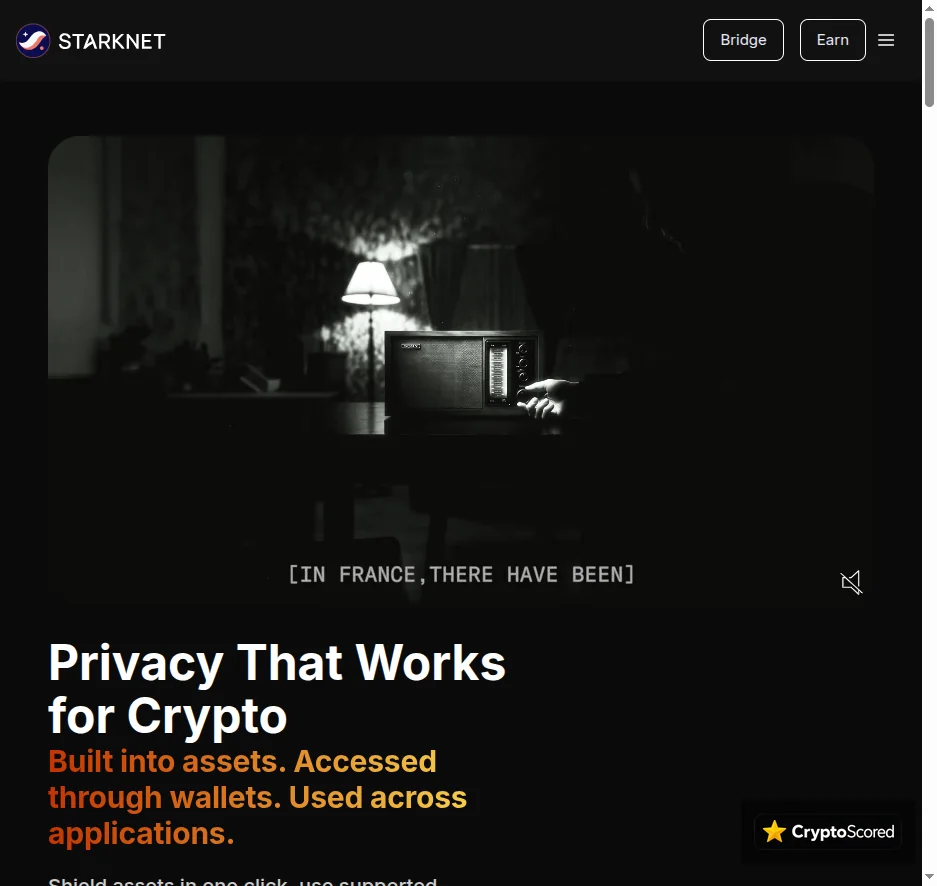
Platform overview
Starknet is a permissionless Ethereum validity rollup built around Cairo, Sierra, and STARK proofs rather than the EVM. It gives developers a proving-oriented contract environment and gives users smart-contract accounts by default, making programmable account behavior part of the normal account model.
Proof-backed batches settle state on Ethereum
The sequencer validates and executes transactions, groups successful ones into blocks, and proposes them. A prover produces a STARK proof for the execution trace and state change, then Ethereum receives that proof and the state difference. The Starknet core contract updates the recognized state only after its verifier accepts the proof.
This means Ethereum does not accept an invalid transition unless the proof verifies, rather than relying on someone to open a later challenge to an unproven claim. Confirmation, block processing, proof production, and Ethereum settlement remain separate stages, however, so a Starknet interaction is not instantly final on Ethereum.
Cairo and smart-contract accounts change the integration work
Cairo is Starknet’s native contract language and Sierra is its current intermediate representation. The design is tailored to proving, but an Ethereum application cannot be treated as a drop-in bytecode deployment: it needs a Cairo-oriented port and Starknet-specific integration work.
A Starknet account is normally a contract that can define signature checks and transaction validation. That lets wallets and applications build account-level features such as passkey authentication, but users need a Starknet-compatible wallet and asset representation. Teams whose priority is direct Solidity, Ethereum RPC, and EVM-tool reuse face a material migration cost.
Three resource prices and bridge messages affect a transfer
Starknet accounts for L2 gas, L1 gas, and L1 data gas. Its v3 transactions sign over all three resource bounds, tying the authorized fee to local computation and Ethereum settlement and data-availability costs. Ethereum blobs can reduce data-publication cost, but the L1-related portion still changes with the relevant resource markets.
StarkGate is the main token bridge system, using contracts on Ethereum and Starknet. A deposit can trigger minting of a corresponding Starknet token, while a withdrawal starts with an L2 message for Ethereum to consume. L1-to-L2 messages need the L2 fee, and a pending deposit cancellation takes approximately five days before it can proceed; bridge transfers are not reversible local wallet moves.
Optimism preserves EVM equivalence instead
Optimism is the close contrasting Layer 2 for direct Ethereum transaction formats and EVM tooling. It uses fault-proof games for disputed state commitments, while Starknet uses proof-verified Cairo execution and native contract accounts. The choice is about the contract and wallet model as well as the proof-versus-challenge route to Ethereum settlement, not only lower fees.
Contact Information
- Website
- https://starknet.io/
- Legal contact
- legal@starkware.com
User Reviews
No reviews yet. Be the first to review this platform.
Other Airdrop Discovery & Tracking Platforms










Explore the Crypto Directory
Discover exchanges, wallets, casinos, mining, trading tools and more.