

Solana
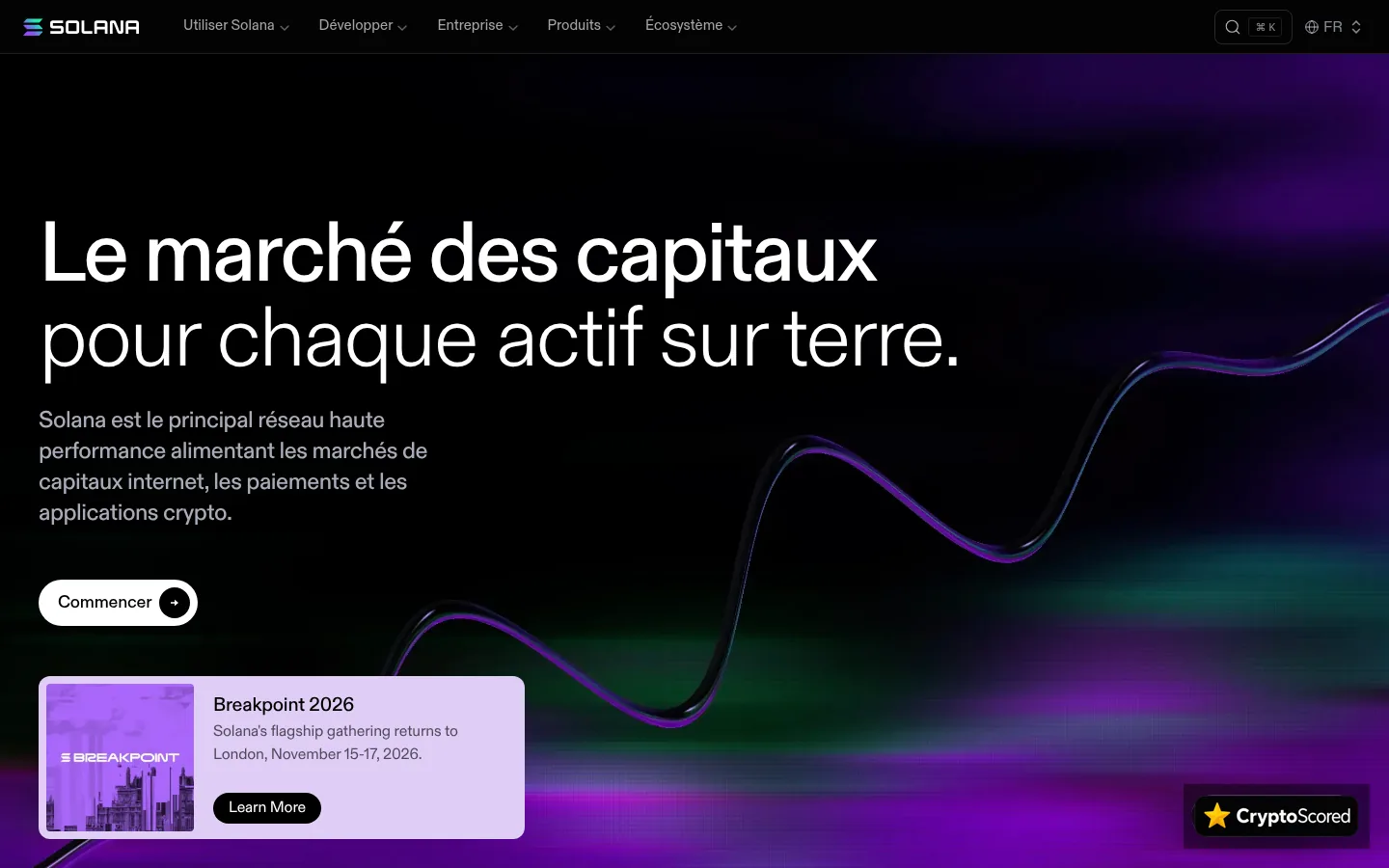
Blockchain Networks →Solana is a public blockchain network for applications, tokens and on-chain transactions.
Verified Facts
- Network · Consensus Mechanism
- POS
- Network · Native Asset
- SOL
Platform overview
Solana is a public proof-of-stake base network for applications, tokens, and direct onchain transactions. SOL pays network fees and can be delegated to validators, while applications run as programs that work through explicit account inputs rather than Ethereum-style contract storage discovery during execution.
Declared accounts make parallel execution possible
A Solana transaction declares the accounts its instructions will read or modify. The runtime can execute transactions in parallel when they do not contend for the same writable accounts, which suits applications whose activity can be spread across independent state.
Parallel execution is not automatic relief for every workload. Transactions that repeatedly touch the same hot account still compete for access. Developers moving from an EVM chain also need to adapt state layout and transaction construction; Solana programs are not a drop-in redeployment of Solidity bytecode.
Short-lived blockhashes shape the transaction experience
Proof of History provides a verifiable timing and ordering sequence, while proof-of-stake validators verify and vote on the ledger and scheduled leaders produce blocks. A normal transaction uses a recent blockhash that is valid for roughly 60 to 90 seconds under documented slot assumptions.
That short window prevents a transaction from waiting indefinitely in a public mempool, but it also means a wallet or application may need to rebuild and re-sign an expired transaction. Durable nonce accounts provide a route for transactions that need to stay valid longer.
SOL connects inclusion costs with validator delegation
The fee payer pays a SOL base fee for each required signature. A prioritization fee based on compute-unit settings can help a transaction compete for a leader’s attention during demand, so complex calls need both an adequate compute budget and a fee setting suited to contention. The base fee is split between burning and the validator.
SOL holders can delegate stake to validators rather than operate one. Delegated stake helps determine validator selection, and commissions are deducted before rewards are shared with delegators. Validator operation remains separate from ordinary wallet use: an RPC node can serve applications without voting, while a voting validator must maintain consensus infrastructure. Current protocol rules do not implement slashing.
BSC trades Solana’s model for EVM portability
BNB Smart Chain is the practical alternative for a team prioritizing Solidity contracts, Geth-style RPC, and existing EVM wallets and libraries. Solana instead asks builders to use its program-and-account model in return for account-aware parallel execution and its own transaction-expiry behavior. The deciding constraint is usually integration and state design, not a generic choice between base networks.
Contact Information
- Website
- https://solana.com/
- Privacy contact
- operations@solana.com
User Reviews
No reviews yet. Be the first to review this platform.
Other Blockchain Networks





Explore the Crypto Directory
Discover exchanges, wallets, casinos, mining, trading tools and more.