

The Graph
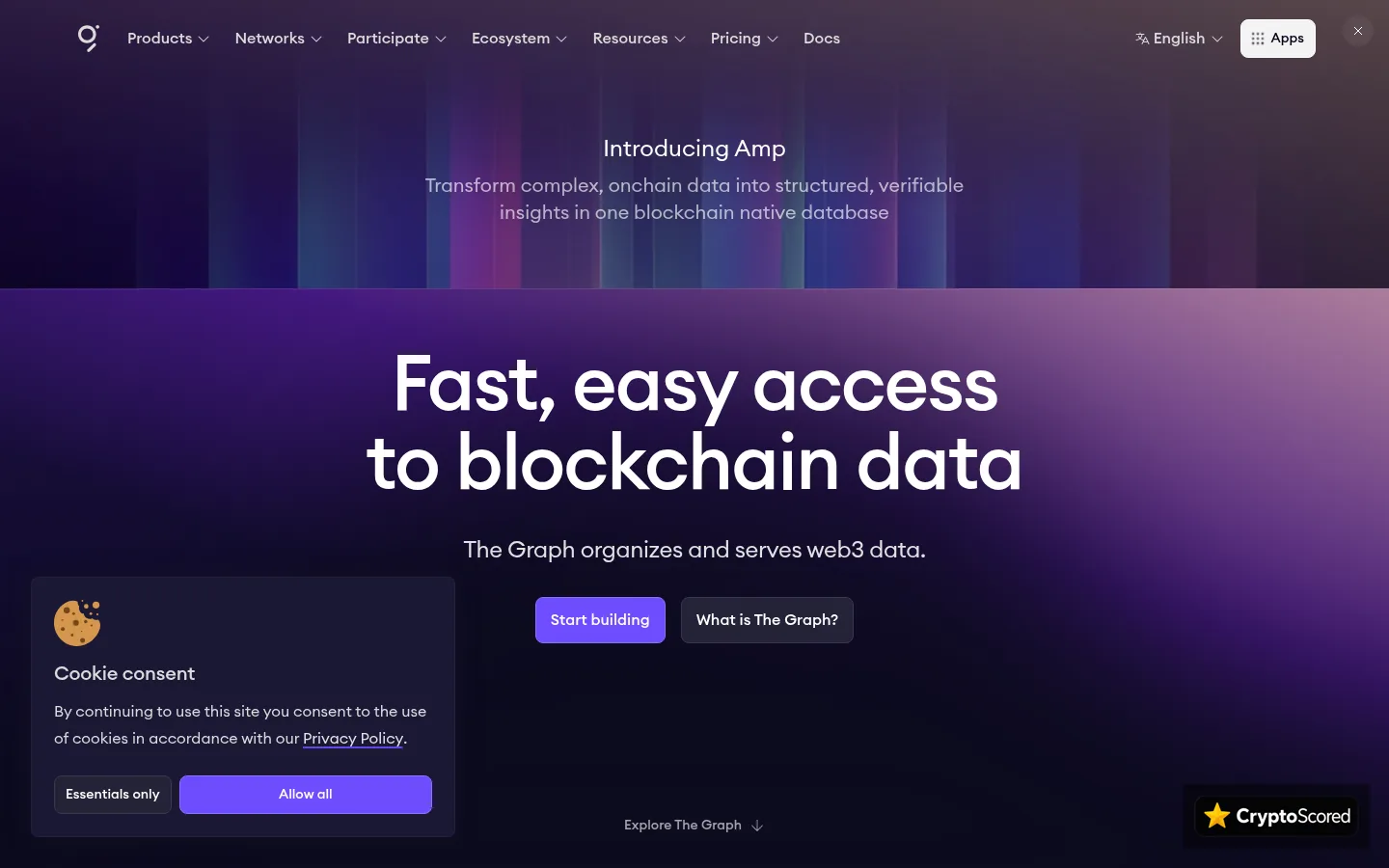
Blockchain Data Indexing & APIs →The Graph is a protocol for indexing and querying blockchain data.
Verified Facts
- Indexing · Access Methods
- API, SQL, SUBGRAPH, WEB
- Indexing · Supported Networks
- Arbitrum Nova, Arbitrum One, Arc, Avalanche, Base, Bitcoin, Blast, BNB Chain, Boba, Botanix, Celo, Chiliz, Ethereum Beacon, Ethereum, Etherlink, Fantom, Gnosis Beacon, Gnosis Chain, Hemi, HyperEVM, Injective EVM, Injective, JOC, Kaia, Linea, Litecoin, MegaETH, Monad, Moonbeam, Moonriver, NEAR, Neo X, Optimism, peaq, Polygon, Polygon zkEVM, Rootstock, Scroll, Sei, Solana, Soneium, Sonic, Stable, Starknet, Stellar, Tempo, TRON EVM, TRON, Unichain, Vaulta, Viction, WAX, World Chain, X Layer, ZetaChain, zkSync Era, Zora
Platform overview
The Graph is an indexing protocol built around Subgraphs: application-specific GraphQL APIs that extract blockchain activity, transform it into a declared data model, and store queryable entities. It is built for a protocol-shaped data layer, not as a general-purpose provider of raw node calls.
Subgraphs turn contract activity into application entities
A Subgraph author declares a GraphQL schema, data sources, and mappings. The schema defines queryable entities, data sources identify events, calls, blocks, or files to watch, and mappings turn those inputs into records such as pools, positions, transfers, proposals, or daily statistics.
This saves each client from repeatedly decoding the same contract activity, but it also makes the schema decisive. Two Subgraphs can cover the same protocol yet expose different fields, aggregation choices, and starting points, so a query can retrieve only what its author modeled and indexed.
GraphQL queries follow the indexed schema
Published Subgraphs have their own GraphQL query URLs. A client selects the fields and relationships it needs from the schema instead of receiving a fixed broad REST response. Timeseries entities and hourly or daily aggregations can also return calculated counts, sums, extrema, and first or last values.
Indexing can start at genesis or a declared block, and grafting can reuse indexed data from a compatible Subgraph up to a selected block. A Subgraph can still lag while syncing, fail from an indexing error, or omit a needed contract or field, so applications with strict freshness or coverage needs must inspect the relevant index and schema.
Custom protocol indexing versus provider-maintained data
The Graph spans EVM and non-EVM ecosystems, but network support does not automatically mean every protocol is indexed. It suits teams prepared to adopt or create a reusable protocol-specific data model, especially where several application views need the same transformed contract data.
Covalent is the close contrast for standardized, provider-maintained REST data across many chains. The Graph gives a team custom Subgraph modeling and GraphQL flexibility; Covalent is more direct for balances, transfers, transactions, token data, and other prebuilt responses. Raw node methods, transaction broadcast, traces, and subscriptions may still require an RPC provider alongside either approach.
Contact Information
- Website
- https://thegraph.com/
- Public-contact status
- No public contact verified on the current official surface
User Reviews
No reviews yet. Be the first to review this platform.
Other Blockchain Data Indexing & APIs





Explore the Crypto Directory
Discover exchanges, wallets, casinos, mining, trading tools and more.