

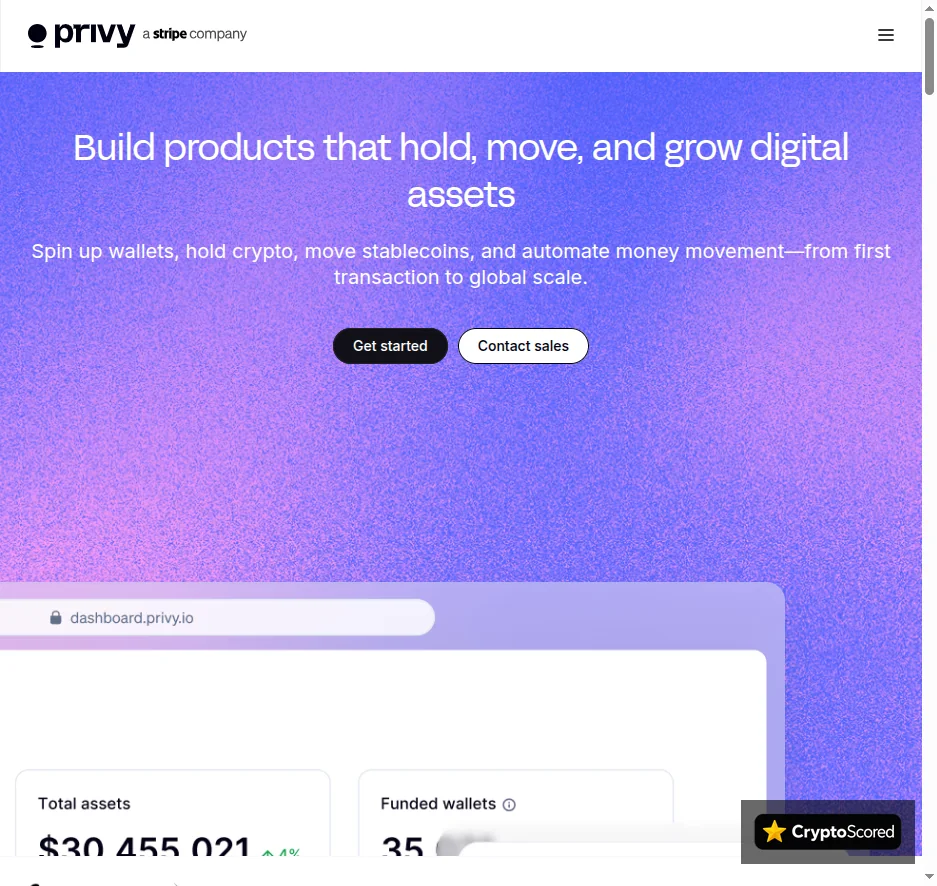
Privy provides wallet infrastructure with email, SMS, passkey, social, Ethereum-wallet, and Solana-wallet authentication methods.
Verified Facts
- Wallet Infra · Integration Types
- SDK, EMBEDDED_WALLET
- Wallet Infra · Auth Methods
- EMAIL_OTP, SMS_OTP, PASSKEY, OAUTH_SOCIAL, ETHEREUM_WALLET, SOLANA_WALLET
Platform overview
Privy is application-facing wallet and authentication infrastructure. It lets a product combine sign-in with an embedded wallet, connect a user’s existing wallet, or use a wallet controlled through the application’s server API; those choices establish different authority and recovery relationships.
Sign-in methods and wallet models serve different roles
A user can authenticate with a passkey, external Ethereum or Solana wallet, social OAuth, or a one-time email or SMS code. That method establishes application access; it is distinct from whether the product creates an embedded wallet or connects an existing onchain account.
Embedded wallets remove the need to begin with a separate wallet app or recovery phrase, while external-wallet connection preserves an existing onchain identity and assets. Social login and emailed or texted codes also depend on their respective credential or delivery providers, even if they lead to the same in-app experience.
Wallet authority must match the product role
Privy distinguishes user-facing embedded wallets from wallets an application server can control through its API. Secure hardware environments protect wallet access, but the application still needs to state clearly whether a user, an application, or several approvers can initiate a given action.
Its policy engine can limit recipients, contracts, transfer values and calldata, and can require multifactor authentication or quorum approvals. Those controls constrain selected wallet actions; they do not substitute for choosing the underlying authority model.
Idempotent submission, webhooks and gas sponsorship
Embedded wallets can transfer assets and interact with contracts, while idempotent transaction submission helps an application avoid resubmitting the same request after a retry. Webhooks for transaction status, deposits and withdrawals make wallet activity available to the product’s backend.
Gas sponsorship and management can make a supported action feel less like a conventional wallet transfer, but the application must still fund it, set policies, support the selected chain and handle failures. Sponsored gas does not make every transaction executable or free.
Application wallet infrastructure versus institutional custody
Privy fits a consumer application, fintech product or game that wants wallet onboarding inside its own sign-in and product flow. It is not primarily a retail wallet chosen by an individual to manage a recovery phrase outside a particular application.
Fireblocks represents the contrasting institutional model: shared custody controls, approval policy and settlement operations for an organisation. Privy supplies the application-integrated user and server wallet model that sits closer to product onboarding than to an institutional asset-control workspace.
Contact Information
- Website
- https://privy.io/
- Contact us
- https://privy.io/contact
User Reviews
No reviews yet. Be the first to review this platform.
Other Wallet Infrastructure Providers







Explore the Crypto Directory
Discover exchanges, wallets, casinos, mining, trading tools and more.