Ondo Finance
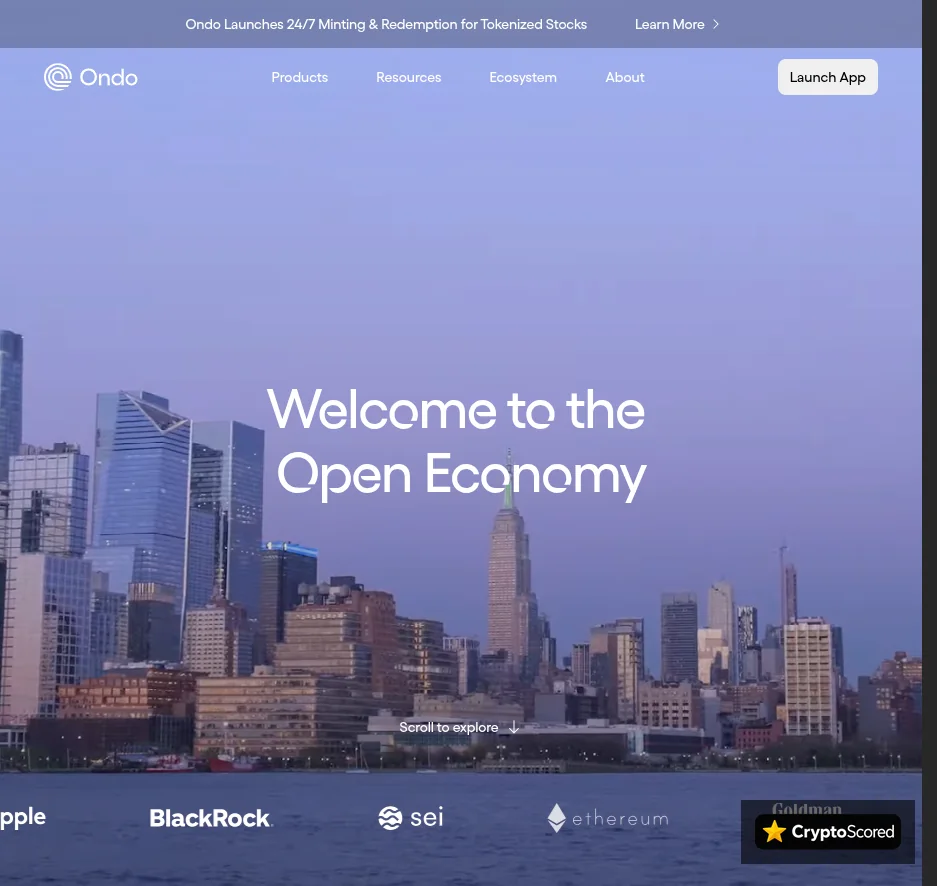
Tokenization & RWA Platforms →A platform offering tokenized products linked to assets such as U.S. Treasuries, stocks, and ETFs.
Verified Facts
- Rwa · Asset Classes
- U.S. Treasuries, U.S. stocks, ETFs, ADRs, GSE securities
- Rwa · Investor Eligibility
- RETAIL, ACCREDITED, INSTITUTIONAL
Platform overview
Ondo Finance issues tokenized Treasury-linked products under its own terms. Its main products are not a marketplace of outside managers: USDY gives eligible non-U.S. holders a tokenized debt instrument backed by bank deposits and short-term U.S. Treasuries, while OUSG is a tokenized fund interest for qualified investors.
USDY expresses Treasury income in two token forms
USDY's return comes from its bank-deposit and short-term Treasury holdings, not from lending demand in an onchain money market. It has daily subscriptions and redemptions and becomes transferable after issuance, allowing a holder to move it into supported onchain uses while direct entry and exit retain the product's onboarding and redemption terms.
Accumulating USDY records the return through a rising value per token. Rebasing rUSDY keeps the unit near one dollar and increases the holder's token balance as yield accrues. They offer the same Treasury-linked exposure in different accounting forms, which matters to wallets and applications that expect either a stable balance or a growing number of units.
Native USDY moves across supported networks
Ondo issues USDY on Ethereum, Mantle, Solana, Sui, Aptos, Noble, Arbitrum, Stellar, Sei, Tempo and BNB Chain. Its bridge burns USDY on the sending network and mints it on the receiving one, moving native USDY rather than creating a separately collateralized wrapped claim.
That broad distribution does not remove the product's access terms. USDY is offered to eligible non-U.S. individuals and organizations, and the available use of the token remains narrower than a claim that every wallet or protocol can use a Treasury-bearing asset in the same way.
OUSG prices shares from fund NAV
OUSG gives accredited investors and qualified purchasers exposure primarily to short-term U.S. Treasuries and government-sponsored enterprise securities. Its portfolio can also include large-manager funds, bank deposits and USDC for liquidity, so it is not a tokenized basket of individual Treasury bills.
A USDC or PYUSD subscription is converted into dollars and divided by current OUSG net asset value to determine the number of shares. Eligible holders can mint and redeem around the clock, but instant transactions have product-set daily limits and lower minimums than non-instant transactions. OUSG shares can transfer continuously even though its investor gate is much narrower than USDY's.
Issued products rather than a manager toolkit
Superstate's USTB is a close option for qualified investors seeking a tokenized short-duration government-securities fund with USDC entry and exit. OUSG differs in that its portfolio can allocate through other Treasury funds as well as hold liquidity assets.
Centrifuge serves a different decision. Ondo defines the issuer, assets and access route for USDY and OUSG; Centrifuge gives independent managers the tools to create their own pools, share classes, investor permissions and multi-chain distribution.
Contact Information
- Website
- https://ondo.finance/
- Product questions
- support@ondo.finance
User Reviews
No reviews yet. Be the first to review this platform.
Other Tokenization & RWA Platforms

Tokenized equities, Tokenized ETFs, Tokenized corporate bonds, Tokenized government bonds / T-bills








Explore the Crypto Directory
Discover exchanges, wallets, casinos, mining, trading tools and more.