

Ledger
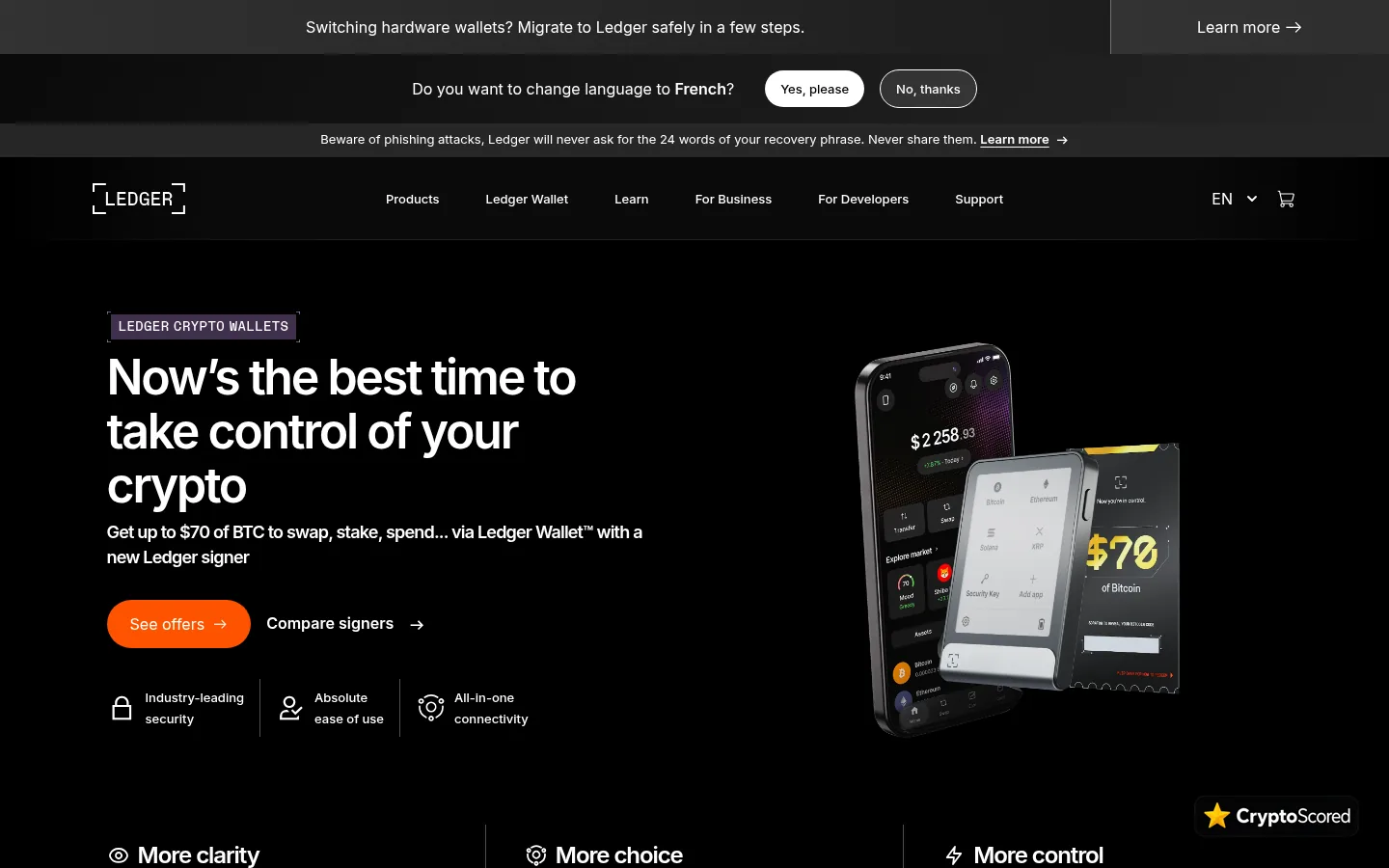
Hardware Wallets →Ledger makes hardware wallets designed to keep crypto private keys offline.
Verified Facts
- Security · Secure Element
- PRESENT
- Technical · Supported Connection Modes
- USB, BLUETOOTH, NFC
Platform overview
Ledger is a family of dedicated hardware signers used with Ledger Wallet and compatible third-party applications. The device protects private-key material and produces signatures; the companion software organizes accounts, prepares transactions and connects to networks without receiving the keys.
Secure Element keys and isolated device applications
Ledger devices generate the recovery phrase and derived private keys in a Secure Element. BOLOS separates installed network applications, so an application for one network does not directly share its internal key material with another. A device PIN controls local use, while the recovery phrase restores the accounts on a compatible replacement device.
The range includes button-and-OLED Nano devices and touchscreen Ledger Stax and Ledger Flex models. Nano S Plus uses USB, Nano X adds Bluetooth, and current touchscreen models use USB-C and Bluetooth, but every transaction still requires confirmation on the hardware screen.
The device signs what the companion app prepares
Ledger Wallet installs the needed device application, reads public account information and can prepare sends, swaps, staking or dapp-related transactions. The signer then displays the details and produces a signature only after physical confirmation, leaving balances, network communication and transaction construction on the phone or computer.
The protection depends on the on-device review. A basic transfer is usually easier to inspect than a complex smart-contract approval, and confirmation is only as informative as the details the relevant device application can display. An optional BIP39 passphrase derives a separate wallet, but recovery then requires preserving both the phrase and the exact passphrase.
Multi-chain accounts with provider and wallet boundaries
Ledger Wallet can group accounts across many chains and broker access to separate providers for selected buying, swapping, staking, earning and card-related services. Those services remain third-party services; Ledger is the signer and wallet interface through which the owner reviews the associated transaction.
A Ledger-compatible asset is not always fully managed in Ledger Wallet. Asset, chain and service support can differ between the device application, the companion app and a compatible third-party wallet, which is why Ledger can also connect to other wallet software and browser dapps for supported networks.
Commercial multi-chain signer versus QR-only Bitcoin focus
SeedSigner is the clearest contrast for a Bitcoin-only holder. It is a stateless DIY signer assembled from Raspberry Pi components and exchanges PSBTs through QR codes; Ledger is ready-made, supports many networks, uses USB or Bluetooth depending on model, and integrates with Ledger Wallet.
Trezor is the closer commercial multi-asset alternative. Both use device-screen confirmations and work with companion software and third-party wallets, but Ledger's design centers on its Secure Element and BOLOS application isolation. The choice also turns on the desired assets, device interface and wallet integrations.
Contact Information
- Website
- https://ledger.com/
User Reviews
No reviews yet. Be the first to review this platform.
Other Hardware Wallets




Explore the Crypto Directory
Discover exchanges, wallets, casinos, mining, trading tools and more.