

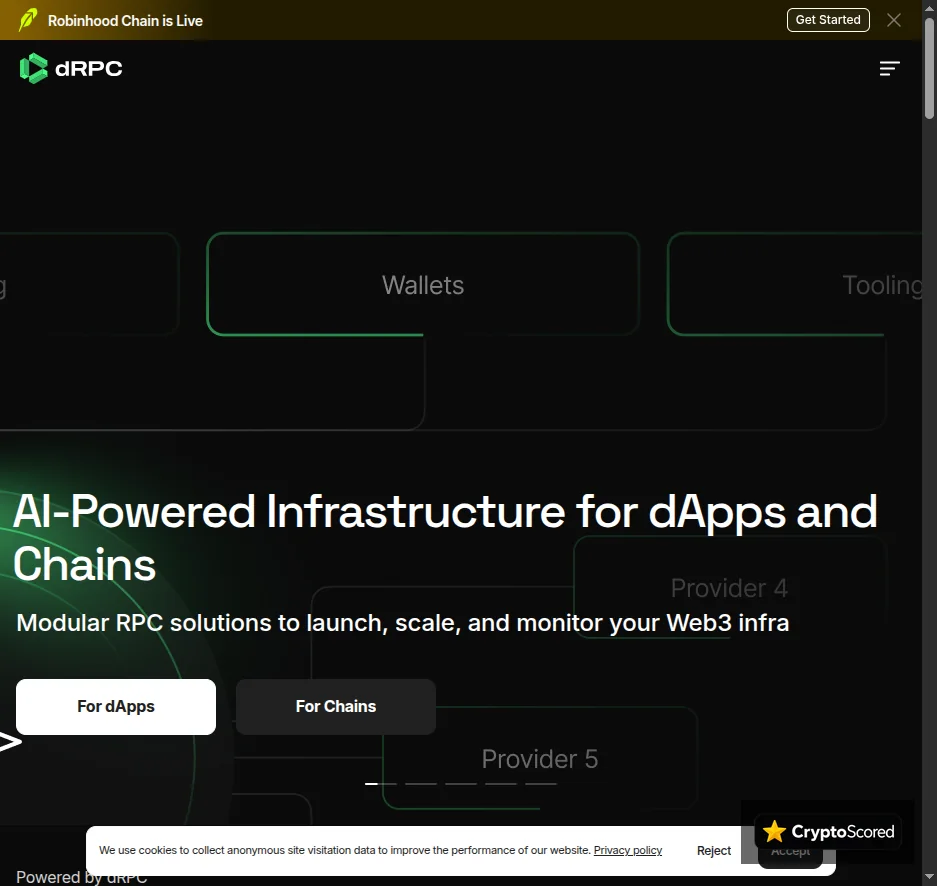
dRPC provides modular RPC infrastructure for blockchain applications and networks.
Verified Facts
- Rpc · Access Authentication
- API_KEY, IP_ALLOWLIST
Platform overview
dRPC provides multichain node access through a distributed network of independent upstream providers. Its NodeCloud endpoints serve applications, while NodeCore offers a self-hosted option for teams that want to run routing and fallback logic themselves.
Public nodes and account-keyed endpoints are different routes
dRPC supplies public HTTPS and WSS endpoints for selected chains, including Ethereum, without an account key. Those public nodes are distinct from the premium route: an account holder creates a key and uses the chain-specific HTTPS or WSS endpoint carrying that key for managed access.
Account-keyed endpoints support standard reads, contract calls, logs, fee estimates, and submission of a pre-signed raw transaction; public endpoints should not be assumed to provide the same method coverage or service level. The key identifies the caller to dRPC, not a blockchain wallet. Signing and custody remain with the wallet or external signer before any transaction reaches the endpoint.
Routing spreads requests across node providers
dRPC’s routing layer load-balances requests and can fall back when an upstream provider is unavailable, reducing dependence on one application-facing node. WebSocket access also supports real-time subscriptions; on Solana, subscriptions can cover account changes, signatures, slots, and logs.
The method surface still varies by chain and plan. Ethereum documentation includes reads, relay, subscriptions, filters, traces, and debugging calls, while Solana uses different RPC methods and subscription types. Public access does not establish that archive queries, persistent filters, traces, or debug calls are included.
Usage and service level change with the plan
Managed traffic is charged in compute units, and subscriptions plus delivered notifications can add to consumption. Request-per-second capacity and monthly compute allowance are separate limits, so an application must account for both its request rate and its method mix.
The free tier uses public nodes, while paid access adds high-performance nodes, the wider provider network, load balancing, analytics, and higher capacity. NodeCore is the alternative for a team that needs to operate its own routing layer; it gains deployment control but takes on node connections, monitoring, configuration, and security.
Contact Information
- Website
- https://drpc.org/
- Support
- https://support.drpc.org/
User Reviews
No reviews yet. Be the first to review this platform.
Other RPC & Node Providers



Aptos, Arbitrum, Avalanche, Bitcoin Cash, BNB Smart Chain, Bitcoin SV, Bitcoin, Bitcoin Gold, Cronos, Dash, DigiByte, Dogecoin, Polkadot, Ethereum Classic, Ethereum, Fantom, Fuse.io, Moonbeam, Gnosis Chain, Huobi ECO Chain, KuCoin Community Chain, Kusama, Polygon, Moonriver, NEAR Protocol, Harmony, Ontology, Optimism, Rootstock, Solana, Theta, TON, Tron, NEM, Monero, Zcash

BNB Chain, CORE, Ethereum, Neo, Polygon, Sui, Theta, ZetaChain

Akash, Arbitrum, Arbitrum Sepolia, AtomOne, Avalanche (C-Chain), Base, Base Sepolia, Berachain, Blast, BNB, Boba, Celo, Cheqd, Chihuahua, Ethereum, Ethereum Sepolia, Fantom, Fetch, Fraxtal, Fuse, GIWA Sepolia, Gnosis, Harmony, Hyperliquid, Ink, IoTeX, Juno, Kaia, Kava, Linea, Metis, Moonbeam, Moonriver, Near, Oasys, opBNB, Optimism, Optimism Sepolia, Osmosis, Persistence, Pocket, Polygon, Polygon Amoy, Polygon zkEVM, Scroll, Seda, Sei, Shentu, Solana, Sonic, Sui, Taiko, Tron, Unichain, XRPL EVM, XRPL EVM Testnet, zkLink, zkSync
Explore the Crypto Directory
Discover exchanges, wallets, casinos, mining, trading tools and more.