
Binance
Centralized Exchanges →Binance is a cryptocurrency exchange where users can buy, sell and trade digital assets.
Verified Facts
- Account · Access Requirements
- Account registration, Identity verification, Eligible jurisdiction
Platform overview
A global exchange built around deep account services
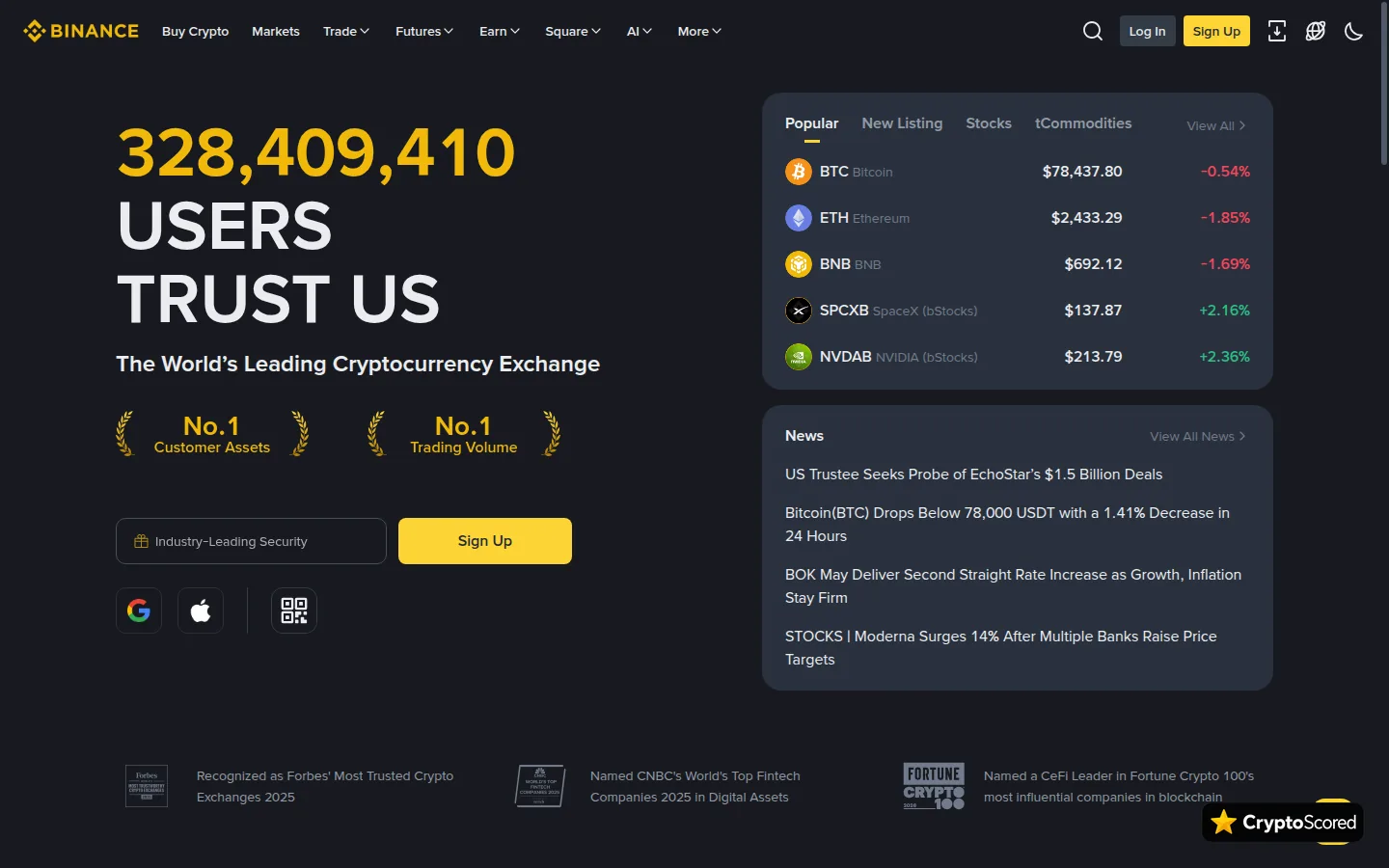
Binance is a major centralized exchange with more than 320 million registered users across more than 180 countries and more than 600 cryptocurrencies available for trading, according to the platform. Its scale supports an account-based exchange that combines large spot order books with futures, Convert, Earn, payments and token-launch programmes, rather than a simple crypto brokerage.
Customers trade balances credited to a Binance account, which Binance holds in custody. Spot, Funding, Margin and Futures wallets separate balances by product, while internal transfers can move assets between them without an on-chain transaction.
Spot markets, order control and BNB fee discounts
Spot trading is Binance's core activity. Market, limit, maker-only, stop-loss, take-profit, OCO and trailing-stop orders give traders different ways to enter or exit listed pairs; spot availability and order constraints can change by market.
Binance tiers spot fees by recent trading volume and BNB balance, and eligible customers can pay fees in BNB at a discount. That connects the exchange token directly to active trading costs rather than treating it only as an asset to hold.
USDⓈ-M and COIN-M futures alongside margin
Margin trading and Binance Futures extend the same account beyond unlevered spot balances. USDⓈ-M futures use stablecoin collateral and settlement, while COIN-M contracts use cryptocurrency collateral and settlement, so the collateral and profit-and-loss denomination are part of the contract choice.
Binance offers perpetual and delivery contracts. Perpetuals use funding payments, while delivery contracts have an expiry and settlement date. Contract availability, leverage, position limits and order features vary by contract and customer eligibility.
Convert, scheduled buying and Simple Earn
Binance Convert swaps supported account assets at a quoted rate instead of through the spot order book. Convert Recurring applies that model to fixed-amount scheduled conversions; it automates purchase timing but does not lock a future price. Spot remains the route for a trader who wants a limit order or visible market depth.
Simple Earn offers Flexible and Locked products for supported assets. Flexible products prioritize redemption access, whereas Locked Products commit assets for a fixed term with set redemption dates. This makes Earn another use for an account balance, with terms, rates, caps and eligible assets varying by product.
BNB across fees, Earn and token launches
BNB's role extends beyond the spot-fee discount. BNB-specific Earn subscriptions can combine several Binance reward streams, and BNB holdings or subscriptions can be relevant to Launchpool, HODLer Airdrops and Megadrop campaigns.
Launchpool distributes tokens from selected projects to customers who subscribe the specified assets under each campaign's calculation rules. The link between BNB, trading fees, Earn and launch distributions is a distinctive part of Binance's account design: the same token can affect both trading costs and access to selected exchange programmes.
Fiat routes, Binance Pay and regional catalogues
Eligible customers can use card purchases, bank-transfer routes, local payment methods or P2P to fund crypto activity, while Binance Pay sends supported crypto from an account balance to other users or participating merchants. Fiat currencies, payment methods, limits and P2P availability depend on the customer's country, verification level and local Binance entity.
That regional split matters: Binance.com access and its product catalogue are not uniform worldwide, and Binance.US is a separate regulated U.S. exchange with its own spot-focused catalogue and U.S.-based custody. Derivatives, Earn and launch-product access can also differ by location and entity.
Coinbase and Kraken: fee design, contracts and local entities
Coinbase Advanced is a close account-based alternative for active spot traders. Its stated fee tier can use either trailing 30-day Advanced-trading volume or total asset balance, applying the lower-fee tier; Binance instead combines recent trading volume with BNB balance and an eligible BNB-payment discount. Both offer derivatives for eligible customers, but Binance's USDⓈ-M and COIN-M futures add a collateral and settlement choice, while Coinbase Advanced advertises perpetual futures with regional availability.
Kraken is another global account exchange with spot, margin and futures access. Like Binance, it uses region-specific entities and product eligibility, but Kraken publishes different terms and futures providers across regions including the United States, EEA, United Kingdom, Australia and others. On both exchanges, the local entity can determine available funding, margin and derivatives products rather than the worldwide brand catalogue.
Contact Information
- Website
- https://binance.com/
User Reviews
No reviews yet. Be the first to review this platform.
Other Centralized Exchanges





Explore the Crypto Directory
Discover exchanges, wallets, casinos, mining, trading tools and more.